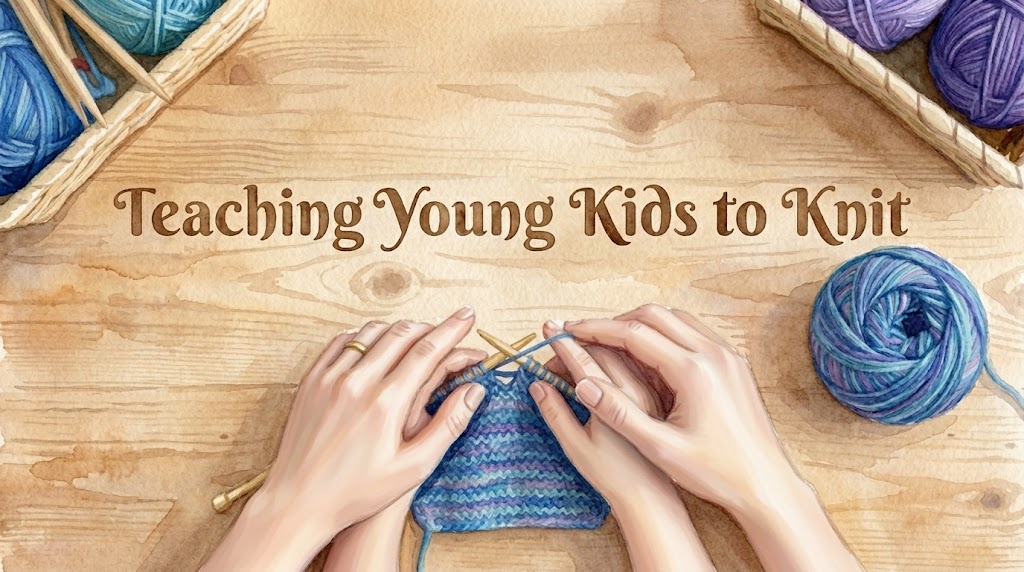
When I learned to knit, I watched a lot of Youtube tutorials and started with casting on. However, when it came to teaching my 7- and 4-year-old, we took a different course. I wanted to avoid screentime, so we didn’t watch any tutorials. Here is my recommended approach based on our own experience.
1. Use medium-weight yarn
A lot of tutorials for adults recommend bulky (#6) yarn and thick needles because the project comes together quickly. For kids, however, I have found that medium-weight (#4) yarn and 6-6.5mm needles are much easier for their little hands to work with. Circular needles are even better because they are shorter and less likely to be dropped. We also use 100% cotton yarn that is less likely to frizz or be poked through by the needle.
2. Start with the knit stitch, English style
To give them a head start and help them stay engaged, do the casting on for them so they could jump right into the knit stitch. I prefer to teach the English style (in which the right hand holds and “throws” the working yarn) because it is easier for beginners. Have your child hold the working yarn and “be” your right hand, looping the yarn around the needle, while you do the rest. Once they mastered the looping, switch: have them hold the needles while you hold the working yarn. When they are familiar with where everything goes, they can be in full control of the yarn and needles while you supervise.
3. Optional: Purl stitch
This step is optional; my 4-year-old was perfectly content to stick with the garter stitch (all knit stitch rows), but the 7-year-old wanted to learn the stockinette pattern. If so inclined, teach the purl stitch in a similar manner, letting them first be the working yarn, then be the needle, then everything together.
4. Optional: Purl-wise slip the last stitch of every row
For most projects, we preferred the more elegant look of slip stitch edges. You can easily teach this to your child by explaining how to bring the yarn to the front before slipping.
5. Cast off their first project
Once they reached the end of their first project, they were skilled enough to do the cast-off themselves. Since casting off is based on the knit stitch, it’s pretty straightforward. If your child is motivated, they might even be able to weave in the loose ends with a tapestry needle. There is nothing like finishing up your very first project! Give a hi-five and take lots of pictures!
6. Cast on a new project
Riding on that wave of excitement, your child may now be ready to tackle the cast-on and start a new project. I’ve found the “butterfly” (longtail) cast on to be easiest for my kids. Holding the yarn in your left hand, have the child hold the needle with you in your right hands. Guide their hand to pass the needle a couple of times, then have them try it themselves. Then have them do the left hand themselves while you supervise.
Your experience may vary. Feel free to follow your child’s lead— you know them best!
As with learning anything, there will be challenges. When we were just starting out, stitches frequently slid off the needles, and I hadn’t learned how to fix that, so we played “frog” a few times— “rip-it, rip-it”. Their work was far from perfect; the row widths were uneven, and there were some large holes. But to the kids, those craggy pieces of fabric they made with their own little hands were the most amazing creation ever.
That said, I do think it was positive for their overall confidence and enjoyment for me to be more hands-on, especially with their first few projects. I would check on them every few rows, and if too many stitches were missing, I would do a few corrective rows myself so that the finished work maintained its overall shape.
I also learned to put in a “lifeline”, which was immensely helpful in avoiding a total rip-it. To do this, after finishing a row, use a tapestry needle to insert a short piece of different-colored yarn— the lifeline— exactly where the knitting needle is. If you ever need to backtrack, you can rip the work up to the lifeline, re-insert the needle, and restart from there.
Behind the scenes, I finished all the sewing parts of their projects, patching holes and hiding uneven edges while I was at it. Sometimes I added borders or embroidered their monogram to hide obvious blemishes. My goal was to make the final products presentable and beautiful, while maintaining the authenticity of the child’s work. They were always thrilled to get their finished project back!
And if they lose interest? It’s okay. Shelve it and try again later. To me, teaching my kids to knit is about doing something fun together. While I do have to nudge them on and help them sometimes, pushing too hard defeats the whole purpose.
Chances are, though, if they see you enjoy something, they would be more likely to be interested and end up enjoying it themselves.
Looking for ideas on what to make? Check out my list of beginner kid-friendly knitting projects!